
Introduction
Moby-Dick by Herman Melville is one of the most influential novels in American literature. First published in 1851, the book is far more than a story about whaling—it is a deep exploration of obsession, fate, human ambition, and the limits of knowledge. Although challenging at times, Moby-Dick rewards readers with powerful symbolism and timeless philosophical questions.
This summary provides an original analysis of the novel’s main ideas and themes, helping readers understand why Moby-Dick continues to matter today.
About the Author: Herman Melville
Herman Melville (1819–1891) was an American novelist, short-story writer, and poet. He drew heavily from his own experiences as a sailor, which strongly influenced Moby-Dick. Although the novel was not successful during his lifetime, Melville is now regarded as one of the greatest figures in world literature.
Book Overview
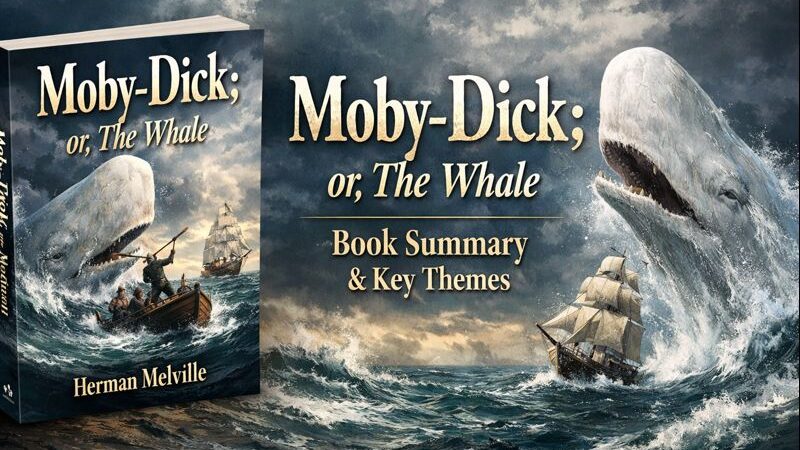
The story is narrated by Ishmael, a sailor who joins a whaling ship called the Pequod. The ship is commanded by Captain Ahab, a mysterious and intense leader who is obsessed with hunting Moby Dick, a massive white whale that previously destroyed his leg.
As the voyage progresses, it becomes clear that the journey is not just a whaling expedition, but a dangerous pursuit driven by Ahab’s personal revenge against the whale. The novel blends adventure, philosophy, scientific descriptions of whales, and deep psychological insight.
Key Ideas & Themes
1. Obsession and Self-Destruction
Captain Ahab represents the dangers of unchecked obsession. His hatred for Moby Dick consumes his identity and blinds him to reason, responsibility, and compassion. Ahab’s refusal to let go ultimately leads to the destruction of himself, his ship, and his crew.
Lesson: Obsession, when left unchallenged, can destroy both the individual and those around them.
2. Man vs. Nature
Moby Dick symbolizes the uncontrollable power of nature. Ahab’s attempt to dominate and defeat the whale reflects humanity’s desire to control forces far greater than itself.
The novel suggests that nature is indifferent to human suffering and ambition, and that trying to conquer it often leads to tragedy.
Lesson: Respect for nature is essential; arrogance toward it invites disaster.
3. Fate and Free Will
Throughout the novel, characters struggle with the question of whether their actions are chosen freely or predetermined. Ahab believes he is destined to confront Moby Dick, while other characters sense an unavoidable doom surrounding the voyage.
Melville leaves this question unresolved, encouraging readers to reflect on how much control humans truly have over their lives.
4. The Search for Meaning
Ishmael, unlike Ahab, is curious and reflective. He seeks understanding rather than domination. His detailed observations about whales, cultures, and human behavior reflect humanity’s ongoing search for meaning in a complex and often confusing world.
Lesson: Curiosity and reflection offer survival, while blind certainty leads to ruin.
Practical Takeaways
- Obsession can narrow perspective and lead to irreversible consequences
- Leadership without empathy is dangerous
- Nature cannot be controlled, only respected
- Seeking knowledge is healthier than seeking revenge
These ideas remain relevant in modern life, especially in leadership, personal ambition, and decision-making.
Final Thoughts
Moby-Dick is a demanding but deeply rewarding novel. While its language and structure may feel challenging, its themes are universal and timeless. The book speaks to anyone interested in psychology, philosophy, leadership, or the human struggle against forces beyond control.
Readers who approach the novel with patience will discover a powerful meditation on humanity’s strengths and flaws.
Disclaimer
This article is an original summary and analysis of Moby-Dick; or, The Whale by Herman Melville. It is intended for educational and informational purposes and does not replace reading the original book.