
Introduction
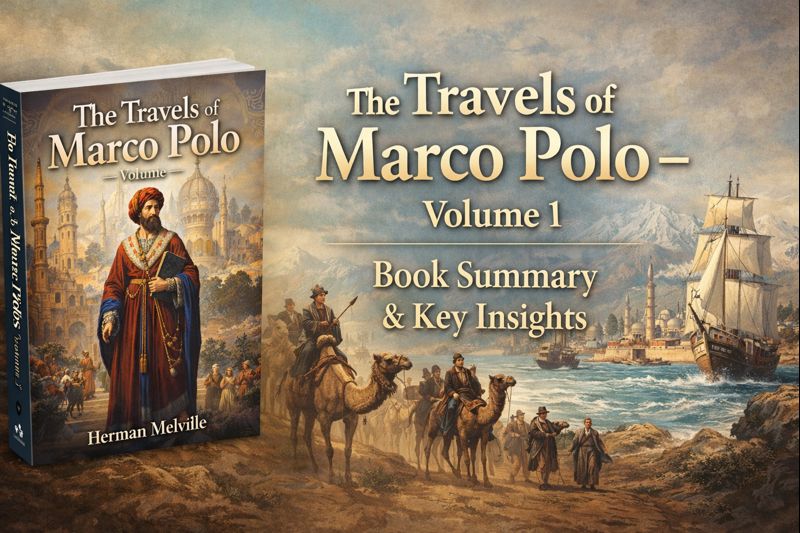
The Travels of Marco Polo – Volume 1 is one of the most important travel books ever written. It documents the remarkable journeys of Marco Polo, a Venetian merchant, across Asia during the 13th century. Written with the help of Rusticiano da Pisa, the book opened European eyes to distant cultures, powerful empires, and unfamiliar traditions.
This summary explores the main ideas, historical value, and lasting influence of the book.
About the Authors
Marco Polo
Marco Polo (1254–1324) was an Italian explorer and merchant who traveled extensively through Asia, including China, Central Asia, and the Middle East. His experiences at the court of Kublai Khan form the core of the book.
Rusticiano da Pisa
Rusticiano da Pisa was a writer who helped Marco Polo record his stories while they were imprisoned together in Genoa. Rusticiano shaped Polo’s oral accounts into a structured narrative.
Book Overview
Volume 1 focuses on Marco Polo’s early travels from Europe to Asia. It describes the long and dangerous journey through Persia, Central Asia, and parts of China. The book provides detailed descriptions of cities, trade routes, customs, religions, and political systems unfamiliar to European readers of the time.
Rather than a personal diary, the book serves as a geographical and cultural record, blending observation with storytelling.
Key Ideas & Themes
1. Exploration and Curiosity
At its core, the book celebrates human curiosity and the desire to explore the unknown. Marco Polo documents lands that were considered mysterious or mythical in medieval Europe.
Lesson: Curiosity drives discovery and expands human understanding.
2. Cultural Diversity
Marco Polo describes a wide range of cultures, religions, languages, and traditions. He approaches many of them with fascination rather than judgment, which was unusual for his era.
Lesson: Exposure to different cultures challenges assumptions and broadens perspective.
3. Trade and Economic Power
Volume 1 places strong emphasis on trade routes, goods such as silk and spices, and the economic importance of cities along the Silk Road. Polo highlights how commerce connects civilizations.
Lesson: Trade is a powerful force that links cultures and drives prosperity.
4. Power and Governance
The book introduces readers to powerful rulers and complex administrative systems, especially in Asia. Marco Polo shows admiration for efficient governance and large-scale organization.
Lesson: Strong leadership and structure shape the success of empires.
Practical Takeaways
Travel deepens understanding beyond books and myths
Cultural openness leads to better communication
Economic systems influence political power
Firsthand observation is a powerful source of knowledge
These ideas remain relevant in today’s globalized world.
Final Thoughts
The Travels of Marco Polo – Volume 1 is more than a travel narrative; it is a historical bridge between East and West. While some accounts have been debated, the book’s influence on geography, exploration, and cultural exchange is undeniable.
Readers interested in history, travel, and world cultures will find this work both educational and inspiring.
Disclaimer
This article is an original summary and analysis of The Travels of Marco Polo – Volume 1 by Marco Polo and Rusticiano da Pisa. It is intended for educational purposes and does not replace the original book.