
Introduction
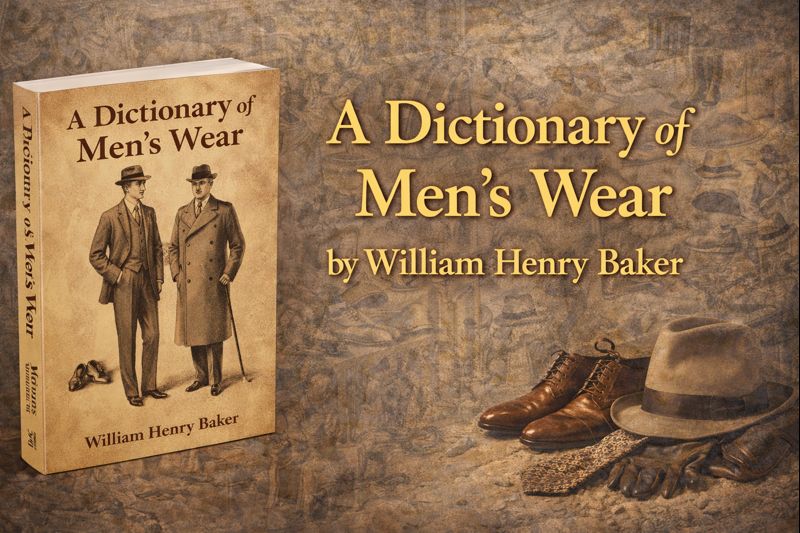
A Dictionary of Men’s Wear by William Henry Baker is a specialized reference work dedicated to the terminology, history, and evolution of men’s clothing. Rather than functioning as a fashion guide, the book serves as an educational dictionary that explains the origins, meanings, and uses of garments, fabrics, tailoring terms, and accessories associated with men’s wear.
The book highlights how men’s clothing reflects social structure, profession, tradition, and cultural identity. By documenting vocabulary related to dress, Baker preserves a historical record of how men’s fashion developed and how language itself plays a role in shaping style.
About the Author: William Henry Baker
William Henry Baker was a writer and editor with a strong interest in craftsmanship, trade knowledge, and practical reference works. His approach in A Dictionary of Men’s Wear reflects careful research and attention to historical detail.
Rather than promoting trends, Baker focuses on clarity, accuracy, and historical continuity, making the book valuable for tailors, historians, designers, and students of costume history.
Purpose and Structure of the Dictionary
The primary purpose of the book is to define and explain terms related to men’s clothing. Organized alphabetically, the dictionary covers a wide range of entries, including:
Garment names
Tailoring techniques
Fabric types
Accessories
Occupational and ceremonial dress
Historical and regional clothing terms
Each entry typically includes explanations of origin, function, and historical usage, allowing readers to understand not only what a term means, but where it comes from.
Men’s Wear as Cultural Language
One of the book’s underlying themes is the idea that clothing operates as a language. Every garment communicates information about the wearer’s role, status, profession, and values.
By defining terms precisely, Baker shows how men’s clothing has long been governed by social rules and expectations rather than personal expression alone.
Key idea: To understand dress, one must understand the vocabulary that describes it.
Garments and Their Functions
The dictionary provides detailed explanations of traditional men’s garments, such as coats, jackets, waistcoats, trousers, shirts, and outerwear. These entries often describe how garments evolved over time in response to climate, occupation, and social norms.
For example, distinctions between formal and informal wear are carefully explained, showing how dress codes developed to structure social interaction.
Tailoring and Craftsmanship
A significant portion of the book focuses on tailoring terms. Baker documents tools, stitches, cuts, and construction techniques used in men’s clothing.
This emphasis reflects a period when garments were custom-made rather than mass-produced. Tailoring vocabulary reveals the high level of skill and precision required to create well-fitting clothing.
The book reinforces the importance of craftsmanship in men’s wear, presenting clothing as a product of labor and expertise rather than disposable fashion.
Fabrics and Materials
The dictionary includes entries on textiles commonly used in men’s clothing, such as wool, linen, cotton, and specialty fabrics. Baker explains differences in texture, durability, and suitability for various garments.
Understanding fabric terminology allows readers to appreciate why certain materials were chosen for specific purposes, such as workwear, formal attire, or seasonal clothing.
Accessories and Finishing Details
Beyond major garments, the book also covers accessories that complete men’s dress, including hats, gloves, neckwear, footwear, and decorative elements.
These items are treated as essential components of proper attire rather than optional additions. Their inclusion highlights how even small details carried social meaning.
Historical and Regional Variations
Baker documents how men’s wear terminology varies across time and place. Some terms reflect medieval or early modern dress, while others relate to more recent developments.
By including obsolete and regional terms, the dictionary preserves linguistic history and shows how fashion evolves alongside language.
Occupational and Ceremonial Dress
The book pays attention to clothing associated with professions, uniforms, and ceremonial roles. These entries demonstrate how dress reinforces authority, identity, and function.
Uniforms, for example, are shown to balance practicality with symbolism, reinforcing discipline and hierarchy.
Men’s Fashion and Social Order
A recurring theme in the dictionary is the relationship between men’s wear and social structure. Dress codes historically reinforced class distinctions, moral expectations, and professional identity.
By defining precise terms, Baker illustrates how clothing served as a visual marker of order and tradition.
Educational and Reference Value
A Dictionary of Men’s Wear remains valuable as:
A reference for costume historians
A resource for designers and tailors
A guide for students of fashion history
A cultural document of dress terminology
The book encourages careful observation and respect for historical context.
Why This Book Still Matters
In a modern world dominated by fast fashion and vague terminology, Baker’s dictionary reminds readers of the depth and precision once associated with men’s clothing.
Understanding traditional terms fosters appreciation for craftsmanship, quality, and the cultural meaning of dress.
Practical Takeaways for Modern Readers
Clothing terminology reflects cultural values
Precision in language improves understanding of design
Craftsmanship is central to quality clothing
Fashion history deepens appreciation of modern style
Final Thoughts
A Dictionary of Men’s Wear by William Henry Baker is more than a glossary—it is a cultural record of how men’s clothing was understood, created, and valued. By preserving terminology and explaining its meaning, Baker offers insight into the traditions and social structures that shaped men’s dress.
The book stands as an essential resource for anyone interested in fashion history, craftsmanship, or the cultural language of clothing.
Disclaimer
This article is an original summary and educational analysis of A Dictionary of Men’s Wear by William Henry Baker. It is intended for informational and educational purposes and does not replace the original reference work.