
Introduction
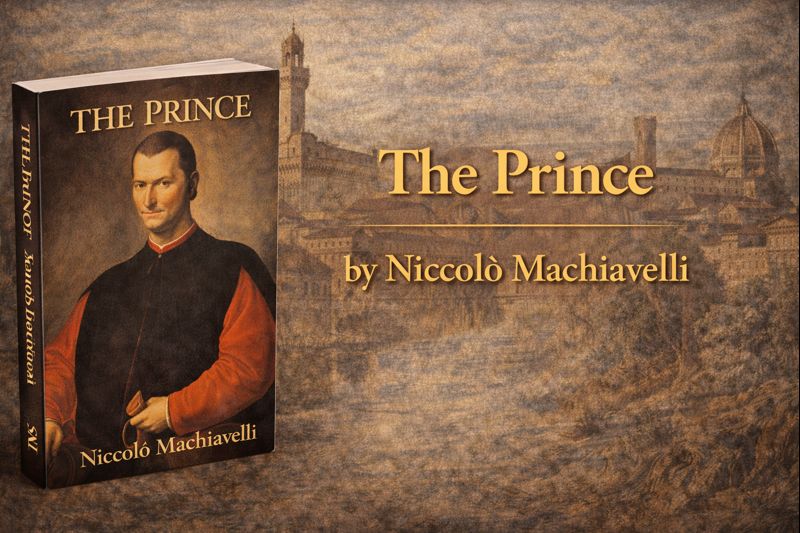
The Prince is a political treatise written by Niccolò Machiavelli in 1513 and published posthumously in 1532. It is one of the most influential and controversial works in political philosophy. Unlike earlier writings that focused on ideal rulers and moral governance, The Prince offers a realistic and pragmatic examination of power, leadership, and statecraft.
Machiavelli’s central concern is not how rulers should behave morally, but how they actually must behave to gain, maintain, and stabilize power in a dangerous and unpredictable political world. This practical approach has shaped political thought for centuries and remains relevant today.
About the Author: Niccolò Machiavelli
Niccolò Machiavelli (1469–1527) was an Italian diplomat, political theorist, and historian from Florence. He lived during a period of intense political instability in Italy, marked by warfare, foreign invasion, and shifting alliances.
Machiavelli’s experiences in diplomacy and government deeply influenced The Prince. Rather than writing from theory alone, he drew on real historical examples from ancient Rome and contemporary European politics.
Purpose and Audience of the Book
The Prince was written as a practical guide for rulers, particularly new princes who had recently acquired power. Machiavelli hoped the book would demonstrate his political insight and potentially restore him to public office.
The book’s purpose is to explain how power works in reality, stripped of idealism. Machiavelli aims to teach rulers how to survive political threats, manage people, and protect the state.
Types of States and How They Are Acquired
Machiavelli begins by classifying states into different types, such as hereditary states, newly acquired states, and mixed states. He argues that hereditary states are easier to govern because people are accustomed to the ruling family.
New states, however, are more difficult to control. Conquest creates instability, resistance, and resentment. Machiavelli advises rulers to eliminate rival claimants and establish firm control quickly to prevent rebellion.
The Role of Fortune and Virtù
One of Machiavelli’s most important concepts is the relationship between fortune and virtù.
Fortune represents chance, luck, and external circumstances beyond human control.
Virtù refers to a ruler’s strength, skill, intelligence, decisiveness, and adaptability.
Machiavelli argues that successful rulers do not rely on fortune alone. Instead, they use virtù to shape events, respond to change, and seize opportunities.
Key idea: Fortune favors those who are bold and prepared.
Military Power and Security
Machiavelli emphasizes that a strong military is essential for any stable state. He warns against relying on mercenaries or auxiliary troops, whom he considers unreliable and dangerous.
A prince must either command his own army or ensure direct control over military forces. Without military strength, laws and authority cannot be enforced.
Fear vs. Love
One of the most famous arguments in The Prince concerns whether it is better for a ruler to be loved or feared.
Machiavelli concludes that while it is ideal to be both, it is safer to be feared than loved if one must choose. Love depends on loyalty, which can fade, whereas fear is maintained through the threat of punishment.
However, Machiavelli warns that fear should never turn into hatred. A ruler must avoid unnecessary cruelty and respect property and family.
Cruelty and Mercy
Machiavelli argues that cruelty, if used, should be swift, decisive, and limited. Prolonged or repeated cruelty breeds hatred and instability.
Mercy, on the other hand, can be dangerous if it leads to disorder. A ruler must balance compassion with firmness, always prioritizing the security of the state.
Appearance vs. Reality
Machiavelli stresses the importance of appearance in politics. A ruler does not need to be morally virtuous but must appear virtuous.
Princes should seem merciful, faithful, religious, and just, even if circumstances require them to act otherwise. Public perception, Machiavelli argues, is more important than inner intention.
Key idea: People judge by appearances more than by reality.
Religion and Morality
Machiavelli treats religion as a political tool rather than a moral guide. He believes religious appearances can help maintain social order and loyalty.
However, he separates personal morality from political necessity. Actions that may be immoral in private life can be justified if they protect the state.
Advice on Leadership and Decision-Making
Machiavelli advises rulers to act decisively and avoid indecision. Hesitation invites weakness and external threats.
He also emphasizes the importance of choosing capable advisors while maintaining ultimate authority. A wise prince listens but decides independently.
The Role of the People
Although often portrayed as cynical, Machiavelli recognizes the importance of popular support. A ruler who has the people’s favor is more secure than one who relies solely on elites.
He argues that the common people desire stability and protection more than power, making their support easier to maintain.
Political Realism and Legacy
The Prince is often associated with the term “Machiavellian,” meaning ruthless or manipulative. However, Machiavelli’s true contribution lies in his realism. He describes politics as it exists, not as it should be.
The book laid the foundation for modern political science by separating politics from theology and ideal morality.
Why The Prince Still Matters Today
In modern politics, business, and leadership, Machiavelli’s insights remain relevant. Issues of power, image, leadership, and strategy continue to shape institutions and societies.
The book encourages readers to question idealism and understand the mechanisms behind authority and influence.
Practical Takeaways for Modern Readers
Power requires adaptability and decisiveness
Appearances strongly influence public judgment
Leadership demands responsibility, not idealism
Stability often requires difficult choices
Final Thoughts
The Prince is a challenging and provocative work that forces readers to confront uncomfortable truths about power and leadership. Machiavelli does not celebrate cruelty or deception; instead, he argues that effective leadership must be grounded in reality rather than moral fantasy.
The book remains a timeless study of political behavior and human nature. Whether admired or criticized, The Prince continues to shape how we understand power, authority, and governance.
Disclaimer
This article is an original summary and political analysis of The Prince by Niccolò Machiavelli. It is intended for educational and informational purposes and does not replace reading the original work.