
Introduction
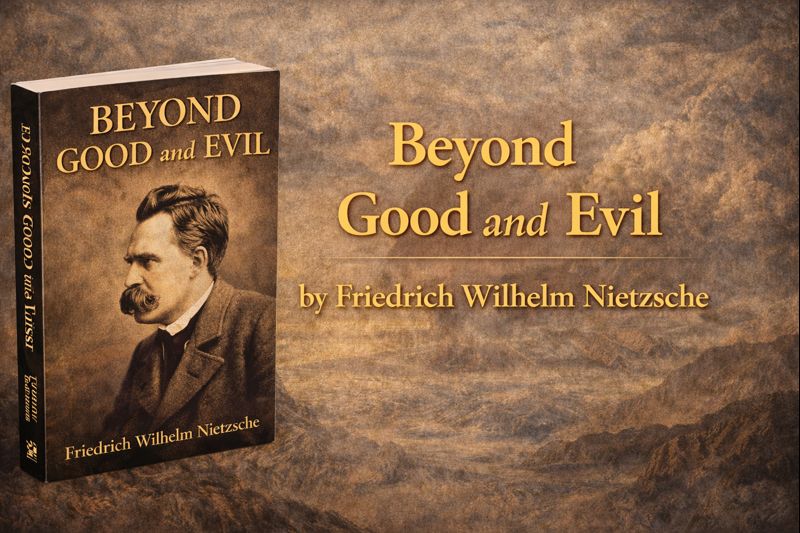
Beyond Good and Evil by Friedrich Wilhelm Nietzsche, first published in 1886, is one of the most important works of modern philosophy. In this book, Nietzsche moves away from poetic symbolism, as seen in Thus Spake Zarathustra, and presents his ideas in a more direct, critical, and aphoristic style.
The book serves as a sharp critique of traditional morality, philosophy, religion, and social values. Nietzsche challenges readers to question inherited beliefs about truth, good and evil, knowledge, and human motivation. Rather than offering a moral system, he seeks to expose the hidden assumptions behind moral judgments.
About the Author: Friedrich Wilhelm Nietzsche
Friedrich Nietzsche (1844–1900) was a German philosopher whose work reshaped modern thought. He rejected absolute truths and traditional moral systems, arguing instead for intellectual independence, self-creation, and psychological honesty.
Beyond Good and Evil marks a mature phase of Nietzsche’s philosophy, where his critiques become more systematic and focused on exposing the foundations of Western thought.
Purpose and Structure of the Book
The purpose of Beyond Good and Evil is to prepare readers for what Nietzsche calls a “philosophy of the future.” He aims to dismantle old philosophical assumptions that he believes restrict human potential.
The book is divided into nine main parts, composed mostly of short aphorisms and essays. These sections address topics such as:
Philosophical prejudice
Morality and values
Religion and society
Psychology and human drives
Culture, politics, and power
Rather than presenting a linear argument, Nietzsche invites readers to actively engage and interpret his ideas.
Critique of Traditional Philosophy
Nietzsche begins by criticizing traditional philosophers for claiming to seek truth while unconsciously defending their own moral prejudices. He argues that philosophy is not purely rational but deeply influenced by psychological drives.
According to Nietzsche, philosophers often present their personal values as universal truths. He challenges concepts such as absolute truth, objective morality, and disinterested knowledge.
Key idea: Philosophy is shaped by human instincts, not detached reason.
Beyond “Good” and “Evil”
The title reflects Nietzsche’s rejection of traditional moral binaries. He argues that concepts of “good” and “evil” are not universal truths but human constructions shaped by history, power, and culture.
Nietzsche distinguishes between master morality and slave morality:
Master morality values strength, creativity, confidence, and excellence.
Slave morality values humility, obedience, pity, and equality, often as a reaction against power.
He argues that modern morality is largely shaped by slave morality, which discourages greatness and individuality.
The Psychology of Morality
Nietzsche treats morality as a psychological phenomenon. He explores how fear, resentment, and weakness influence moral systems.
Moral judgments, he argues, are often expressions of hidden desires rather than rational conclusions. By analyzing morality psychologically, Nietzsche aims to free individuals from unconscious moral conditioning.
Truth, Knowledge, and Perspective
One of Nietzsche’s most radical ideas is perspectivism—the belief that there are no absolute truths, only interpretations shaped by perspective.
He does not deny reality but argues that human knowledge is always influenced by context, culture, and instinct. Truth, therefore, is something created and refined, not discovered in pure form.
Religion and Criticism of Christianity
Nietzsche strongly criticizes Christianity, which he sees as promoting guilt, self-denial, and moral weakness. He argues that religious morality suppresses natural human instincts and discourages self-affirmation.
Rather than liberating individuals, Nietzsche believes religion has historically reinforced obedience and conformity.
The Will to Power
A central concept in the book is the will to power, which Nietzsche describes as the fundamental drive behind human behavior. This drive is not simply about domination over others, but about growth, self-expression, and overcoming resistance.
Art, philosophy, ambition, and creativity are all expressions of the will to power. Nietzsche presents this idea as a more honest explanation of human motivation than moral idealism.
Nobility, Culture, and the Individual
Nietzsche introduces the idea of a new philosophical elite—individuals capable of creating values rather than following them. These individuals are not defined by social class but by intellectual courage and self-discipline.
He criticizes mass culture, nationalism, and herd thinking, arguing that they suppress excellence and originality.
Women, Society, and Controversy
Some passages in Beyond Good and Evil are controversial, particularly Nietzsche’s comments on women and gender roles. These sections reflect both his historical context and his tendency to provoke.
Modern readers often interpret these passages critically, separating Nietzsche’s broader philosophical insights from specific cultural biases.
Style and Literary Approach
Nietzsche’s aphoristic style is deliberate. Short, sharp statements force readers to pause, reflect, and question their assumptions.
The book does not aim to persuade gently; it aims to challenge and disturb.
Cultural and Philosophical Impact
Beyond Good and Evil has had a profound influence on philosophy, psychology, literature, and political theory. Thinkers such as Freud, Jung, Foucault, and Heidegger engaged deeply with Nietzsche’s ideas.
The book helped redefine how modern thinkers approach morality, truth, and power.
Why the Book Still Matters Today
In a world questioning traditional authority, morality, and identity, Beyond Good and Evil remains highly relevant. It speaks to individuals seeking intellectual independence and encourages critical thinking in the face of inherited beliefs.
Nietzsche’s call to examine hidden assumptions is especially important in modern cultural and ideological debates.
Practical Takeaways for Modern Readers
Question inherited moral beliefs
Recognize psychological motives behind values
Embrace responsibility for meaning
Value self-development over conformity
Final Thoughts
Beyond Good and Evil is a demanding but transformative work. Nietzsche does not offer comfort or simple answers. Instead, he invites readers to confront uncertainty, challenge tradition, and take responsibility for their own values.
The book stands as a powerful critique of moral dogmatism and a bold invitation to intellectual freedom. For readers willing to engage deeply, it offers insight into both human psychology and the future of philosophy.
Disclaimer
This article is an original summary and philosophical analysis of Beyond Good and Evil by Friedrich Wilhelm Nietzsche. It is intended for educational and informational purposes and does not replace the original book.