
Introduction
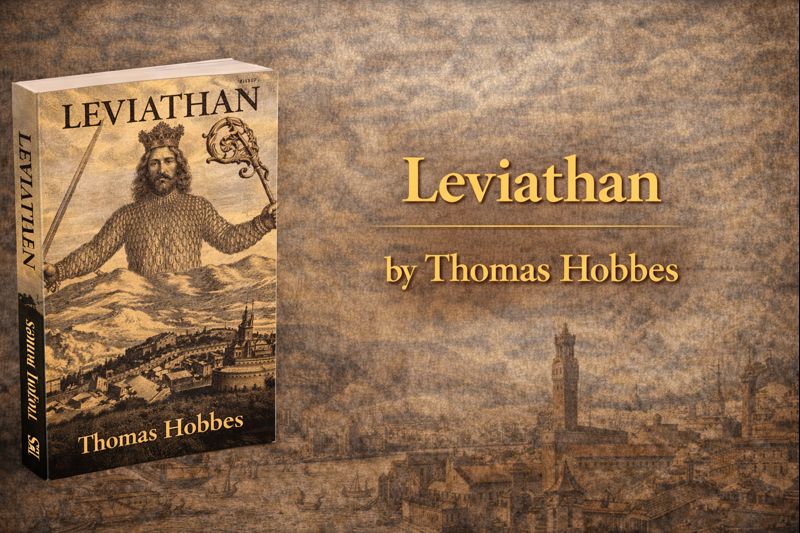
Leviathan, published in 1651 by Thomas Hobbes, is one of the most important works in the history of political philosophy. Written during a period of civil war and political instability in England, the book seeks to explain the nature of human beings, the origins of political authority, and the necessity of strong government.
Hobbes presents a systematic theory of society and the state, arguing that peace and order can only be achieved through a powerful central authority. His work laid the foundation for modern political thought, particularly theories of sovereignty, social contracts, and state power.
About the Author: Thomas Hobbes
Thomas Hobbes (1588–1679) was an English philosopher best known for his materialist view of human nature and his pessimistic assessment of human behavior. Living through war and political chaos deeply influenced his belief that strong authority was necessary to prevent violence and disorder.
Hobbes sought to apply scientific reasoning to politics, treating human behavior as something that could be analyzed logically and systematically.
Purpose and Structure of the Book
Leviathan is divided into four main parts, each addressing a different aspect of Hobbes’s philosophy:
Of Man
Of Commonwealth
Of a Christian Commonwealth
Of the Kingdom of Darkness
Together, these sections form a comprehensive explanation of human nature, political authority, and the relationship between religion and the state.
Human Nature and the State of Nature
Hobbes begins by analyzing human psychology. He argues that humans are driven by desire, fear, and self-interest. According to Hobbes, people naturally seek power and resources to ensure their survival.
In the absence of political authority, humans exist in what Hobbes calls the state of nature—a condition of complete freedom but also complete insecurity.
In this state:
There is no law or justice
Everyone has a right to everything
Life is characterized by constant fear and conflict
Hobbes famously describes life in the state of nature as “solitary, poor, nasty, brutish, and short.”
Fear and the Desire for Security
Fear plays a central role in Hobbes’s philosophy. The fear of violent death motivates humans to seek peace and stability. Hobbes argues that rational individuals recognize that cooperation is preferable to constant conflict.
This recognition leads people to give up certain freedoms in exchange for security.
The Social Contract
To escape the chaos of the state of nature, individuals enter into a social contract. By this agreement, people surrender their natural right to govern themselves and transfer authority to a single ruler or governing body.
This authority is called the sovereign.
The social contract is not between the ruler and the people, but among individuals themselves. The sovereign exists to enforce laws and maintain peace.
The Leviathan: Absolute Sovereignty
The sovereign, symbolized by the Leviathan, must possess absolute power to be effective. Hobbes argues that divided authority leads to conflict and civil war.
The sovereign’s responsibilities include:
Making and enforcing laws
Protecting citizens from external and internal threats
Maintaining order and justice
Citizens have a duty to obey the sovereign as long as the sovereign provides protection.
Limits of Obedience
Although Hobbes supports strong authority, he recognizes one important limit: self-preservation. If the sovereign directly threatens a person’s life, that individual has the right to resist.
However, rebellion against the sovereign as a political act is almost never justified, as it risks returning society to the chaos of the state of nature.
Law, Justice, and Morality
For Hobbes, laws are commands issued by the sovereign. Justice exists only where there is law, and law exists only where there is political authority.
Moral concepts such as right and wrong do not exist naturally; they are created and enforced by the state. This view separates morality from religion and tradition, making Hobbes a pioneer of political realism.
Religion and Political Authority
In the later sections of Leviathan, Hobbes addresses religion and its role in society. He argues that religious authority must be subordinate to political authority to prevent conflict.
Hobbes feared that competing religious interpretations could undermine social order. Therefore, the sovereign must control public religious doctrine and practice.
The Kingdom of Darkness
In the final part of the book, Hobbes criticizes what he calls the “Kingdom of Darkness”—confusion, superstition, and misuse of religious authority that threaten political stability.
He argues that unclear religious doctrines and independent clerical power create division and weaken the state.
Political Realism and Innovation
Hobbes’s philosophy is notable for its realism. He does not assume humans are naturally good or moral. Instead, he builds his political theory on fear, desire, and rational self-interest.
This approach influenced later thinkers such as John Locke, Jean-Jacques Rousseau, and modern political science.
Criticism and Controversy
Leviathan was controversial from its publication. Critics accused Hobbes of promoting authoritarianism and undermining religious authority.
However, supporters argue that Hobbes prioritized peace and security in a time of violence and instability.
Why Leviathan Still Matters Today
Modern debates about government power, civil liberties, and security often reflect Hobbesian questions. During crises such as war or pandemics, societies still grapple with how much authority governments should have.
Hobbes’s emphasis on order, authority, and fear remains relevant in understanding political behavior.
Practical Takeaways for Modern Readers
Political authority arises from the need for security
Absolute freedom can lead to chaos
Strong institutions prevent violence
Order often requires sacrifice of individual liberty
Final Thoughts
Leviathan is a challenging but foundational work that reshaped political philosophy. Thomas Hobbes presents a stark view of human nature and argues that peace depends on strong, unified authority.
Whether one agrees with his conclusions or not, Leviathan forces readers to confront fundamental questions about freedom, power, and the price of social order. Its influence continues to shape political theory and public debate to this day.
Disclaimer
This article is an original summary and philosophical analysis of Leviathan by Thomas Hobbes. It is intended for educational and informational purposes and does not replace reading the original work.