
Introduction
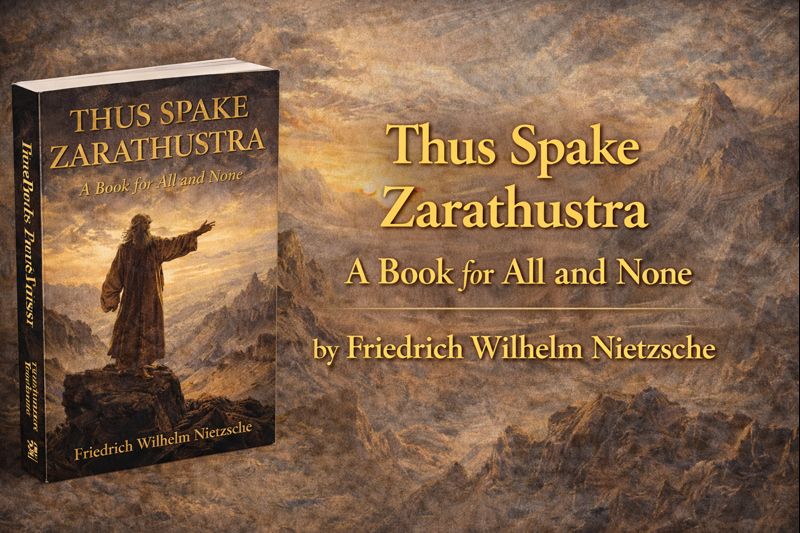
Thus Spake Zarathustra is one of the most influential and controversial philosophical works written by Friedrich Wilhelm Nietzsche. First published between 1883 and 1885, the book is a philosophical novel presented in a poetic and symbolic style. Unlike traditional philosophy, Nietzsche conveys his ideas through sermons, parables, and dramatic imagery delivered by the fictional prophet Zarathustra.
The book challenges conventional morality, religion, and social values, calling for a radical rethinking of human purpose and self-development. It is not meant to provide easy answers, but to provoke deep reflection and personal transformation.
About the Author: Friedrich Wilhelm Nietzsche
Friedrich Nietzsche (1844–1900) was a German philosopher, classical scholar, and cultural critic. His work questioned traditional morality, religion, and metaphysics, emphasizing individual strength, creativity, and intellectual independence.
Nietzsche’s writing often combines philosophy, literature, and psychology. Thus Spake Zarathustra represents the most artistic and symbolic expression of his philosophical vision.
Structure and Narrative Style
The book is divided into four parts, each consisting of short speeches and reflections delivered by Zarathustra. The narrative resembles a religious text, but its purpose is the opposite of traditional religious teaching.
Zarathustra leaves his mountain solitude to share wisdom with humanity, only to discover that most people resist deep self-examination and prefer comfort over truth. His journey reflects Nietzsche’s critique of society and the difficulty of communicating transformative ideas.
The Central Figure: Zarathustra
Zarathustra is inspired by the ancient Persian prophet Zoroaster but is reimagined as a philosophical teacher. He represents the voice of Nietzsche’s ideas rather than a historical or religious figure.
Zarathustra is not a savior; instead, he encourages individuals to overcome themselves. He teaches through metaphor, contradiction, and provocation, emphasizing personal responsibility rather than obedience.
The Concept of the Übermensch (Overman)
One of the book’s most famous ideas is the Übermensch, often translated as the “Overman” or “Superman.” Nietzsche presents the Übermensch as an ideal human being who creates their own values rather than inheriting them from tradition or religion.
The Übermensch represents self-mastery, creativity, and affirmation of life. This figure is not defined by power over others, but by the ability to overcome inner limitations and fear.
Key idea: Humanity is a bridge, not a final destination.
Critique of Traditional Morality
Nietzsche strongly criticizes traditional moral systems, particularly those rooted in religion. He argues that such systems promote obedience, guilt, and weakness rather than strength and self-realization.
Zarathustra challenges concepts such as absolute good and evil, suggesting that moral values are human creations shaped by historical and psychological forces.
The Death of God
One of the most misunderstood ideas in the book is the declaration that “God is dead.” Nietzsche does not mean a literal death, but rather the collapse of traditional religious authority and metaphysical certainty in modern society.
This moment creates both danger and opportunity. Without external moral authority, individuals must take responsibility for creating meaning in their own lives.
The Will to Power
Although not always explicitly named, the will to power is a central theme. Nietzsche describes it as the fundamental drive of life—the desire to grow, overcome resistance, and express strength.
This concept is not merely about domination but about self-expansion and creative transformation. It is the force behind artistic creation, personal growth, and philosophical inquiry.
Eternal Recurrence
Another major philosophical idea in the book is eternal recurrence—the notion that life may repeat itself endlessly in the same form. Nietzsche presents this idea as a test of one’s attitude toward life.
If one could accept living the same life again and again without regret, it would represent the highest affirmation of existence.
Key question: Can you say “yes” to life in all its suffering and joy?
The Criticism of the “Last Man”
Nietzsche introduces the concept of the Last Man, a symbol of modern complacency. The Last Man seeks comfort, safety, and pleasure above all else, avoiding struggle, ambition, and creativity.
This figure represents Nietzsche’s fear that society might abandon greatness in favor of mediocrity.
Loneliness and the Individual Path
Zarathustra repeatedly experiences isolation. His teachings are misunderstood, rejected, or trivialized. This reflects Nietzsche’s belief that true thinkers and creators often walk alone.
The book emphasizes that personal transformation requires courage, solitude, and resistance to social pressure.
Language, Poetry, and Symbolism
Unlike conventional philosophy, Thus Spake Zarathustra is written in poetic and symbolic language. Mountains, animals, light, and movement serve as metaphors for intellectual and spiritual states.
This style encourages interpretation rather than passive acceptance, making each reading a personal experience.
Cultural and Philosophical Impact
The book has profoundly influenced philosophy, literature, psychology, and art. Its ideas have been interpreted, debated, and sometimes misused, but its impact remains undeniable.
Thinkers across disciplines have engaged with Nietzsche’s challenge to rethink morality, identity, and meaning.
Why the Book Still Matters Today
In a world facing uncertainty, loss of traditional values, and rapid change, Thus Spake Zarathustra remains relevant. It speaks to individuals seeking meaning beyond convention and encourages responsibility, creativity, and self-reflection.
Practical Takeaways for Modern Readers
Meaning must be created, not inherited
Personal growth requires discomfort and effort
Blind conformity limits human potential
Affirming life includes accepting suffering
Final Thoughts
Thus Spake Zarathustra: A Book for All and None is not an easy book, nor is it meant to be. It challenges readers to question deeply held beliefs and to confront the responsibility of shaping their own values.
Nietzsche does not offer comfort or certainty. Instead, he invites readers to become active participants in their own becoming. The book remains a powerful call to intellectual courage, creativity, and self-overcoming.
Disclaimer
This article is an original summary and philosophical analysis of Thus Spake Zarathustra by Friedrich Wilhelm Nietzsche. It is intended for educational and informational purposes and does not replace reading the original work.