
Introduction
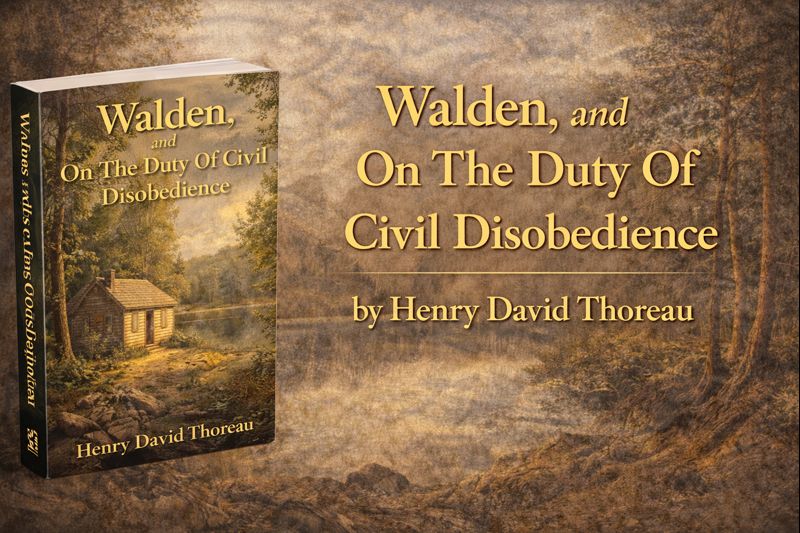
Walden, and On the Duty of Civil Disobedience is a combined edition of two of the most influential works by Henry David Thoreau, an American philosopher, essayist, and naturalist of the 19th century. Together, these texts present a powerful vision of individual conscience, simplicity of life, moral responsibility, and resistance to unjust authority.
While Walden focuses on personal freedom, self-reliance, and harmony with nature, On the Duty of Civil Disobedience addresses the ethical obligation of individuals to oppose unjust laws. Combined, they form a coherent philosophy centered on independence of thought and moral integrity.
About the Author: Henry David Thoreau
Henry David Thoreau (1817–1862) was a central figure in the American Transcendentalist movement. He believed in the inherent goodness of individuals and nature, and he emphasized intuition, conscience, and self-reliance over social conformity.
Thoreau’s ideas influenced major historical figures such as Mahatma Gandhi, Martin Luther King Jr., and Leo Tolstoy. His work continues to shape discussions about civil rights, environmentalism, and ethical living.
Walden: Purpose and Background
Walden is based on Thoreau’s experiment in simple living near Walden Pond in Massachusetts, where he lived for over two years. Thoreau built a small cabin and lived with minimal possessions, seeking to understand life’s essential truths by removing unnecessary complexity.
The book is not merely a memoir but a philosophical reflection on society, nature, and the human condition.
Core Themes of Walden
1. Simplicity and Minimalism
A central theme of Walden is the idea that modern life is unnecessarily complicated. Thoreau argues that people work excessively to maintain lifestyles that do not bring true fulfillment.
He encourages reducing material desires and focusing on what is essential to life.
Key idea: Simplifying life allows individuals to focus on meaning rather than consumption.
2. Self-Reliance and Independence
Thoreau emphasizes self-reliance as a path to personal freedom. He criticizes blind conformity to social expectations and urges individuals to think for themselves.
Living alone at Walden Pond symbolizes intellectual and moral independence rather than isolation.
3. Nature as Teacher
Nature plays a central role in Walden. Thoreau views nature as a source of wisdom, renewal, and spiritual clarity. By observing seasons, animals, and landscapes, he finds lessons about growth, patience, and balance.
Nature, for Thoreau, reflects truths that society often obscures.
4. Critique of Materialism
Thoreau critiques economic systems that prioritize productivity and wealth over human well-being. He argues that many people become enslaved by their possessions and social roles.
True wealth, he suggests, lies in time, freedom, and awareness.
5. Time, Awareness, and Living Deliberately
One of Walden’s most famous ideas is the call to “live deliberately.” Thoreau urges readers to be fully conscious of their choices and actions rather than drifting through life unconsciously.
Style and Structure of Walden
Walden is structured as a series of reflective chapters rather than a linear narrative. Thoreau blends observation, philosophy, humor, and critique, encouraging readers to engage actively with his ideas.
On the Duty of Civil Disobedience: Purpose and Context
On the Duty of Civil Disobedience (often called Civil Disobedience) is a political essay written after Thoreau was jailed for refusing to pay taxes that supported slavery and the Mexican-American War.
In this essay, Thoreau presents a radical argument: individual conscience is superior to government authority.
Core Themes of Civil Disobedience
1. Conscience Over Law
Thoreau argues that citizens should not blindly obey laws that violate moral principles. When laws are unjust, individuals have a duty to resist them peacefully.
Key idea: Moral responsibility does not disappear within political systems.
2. Critique of Majority Rule
Thoreau challenges the idea that majority rule equals justice. He argues that majorities often act based on convenience rather than morality.
Justice, according to Thoreau, comes from ethical reasoning, not numbers.
3. Nonviolent Resistance
Thoreau advocates nonviolent resistance as a moral response to injustice. By refusing cooperation—such as paying taxes—individuals can withdraw support from unjust systems.
This idea later influenced global nonviolent movements.
4. The Role of the Individual
The essay emphasizes that meaningful change begins with individuals willing to act according to conscience, even at personal cost.
Thoreau accepts punishment as part of moral resistance, viewing imprisonment as preferable to moral compromise.
Connection Between Walden and Civil Disobedience
Although different in tone, Walden and Civil Disobedience share a common philosophy:
Walden focuses on personal freedom and ethical living
Civil Disobedience focuses on moral action within society
Together, they argue that true freedom requires both inner independence and outward ethical action.
Cultural and Historical Impact
These works have had a lasting influence on:
Civil rights movements
Environmental philosophy
Political ethics
Literature and philosophy
Leaders such as Gandhi and Martin Luther King Jr. cited Thoreau as a key influence on their strategies of peaceful resistance.
Why the Book Still Matters Today
In a modern world shaped by consumerism, political polarization, and environmental crisis, Thoreau’s ideas remain deeply relevant. His call for simplicity, conscience, and responsibility speaks directly to contemporary challenges.
Practical Takeaways for Modern Readers
Simplify life to focus on meaning
Think independently rather than conforming
Act according to conscience, even when difficult
Respect nature as a source of wisdom
Final Thoughts
Walden, and On the Duty of Civil Disobedience presents a powerful and unified philosophy of ethical living. Thoreau challenges readers to examine how they live, what they support, and whether their actions align with their values.
The book does not demand perfection, but it demands awareness and courage. It remains a timeless invitation to live deliberately, think freely, and act justly.
Disclaimer
This article is an original summary and philosophical analysis of Walden, and On the Duty of Civil Disobedience by Henry David Thoreau. It is intended for educational and informational purposes and does not replace reading the original works.